Saturday, October 22, 2011

Saudi Crown Prince Sultan Dies After Prolonged Illness: Funeral on Tuesday

“May Allah bless the soul of Crown Prince Sultan and grant him the best reward for his services for his religion and homeland.” He died on Saturday, Oct. 22, 2011.

By Siraj Wahab

sirajwahab@arabnews.com

RIYADH: Saudi Crown Prince Sultan bin Abdul Aziz Al-Saud died in the United States on Saturday, the Saudi Press Agency announced. He was 83. His debilitating health problems had kept him out of the public eye for quite some time.

“May Allah bless his soul and grant him the best reward for his services for his religion and homeland,” said a statement from the Royal Court. As crown prince, he was first in the line of succession.

He will be buried in Riyadh on Tuesday, Saudi TV’s Channel 2 announced in its 10:00 a.m. bulletin. The funeral prayers will be held at Imam Turki bin Abdullah Mosque after Asr prayers.

Born in Riyadh in 1928, Crown Prince Sultan was the half-brother of Custodian of the Two Holy Mosques King Abdullah bin Abdul Aziz. He was Saudi Arabia’s deputy prime minister and the minister of defense and aviation, and was a central figure in Saudi decision-making.

He is survived by a number of children; they include Prince Bandar bin Sultan, the former ambassador to the United States who now heads the National Security Council, and Prince Khaled bin Sultan, the deputy defense minister.

King Abdul Aziz Al-Saud founded the Kingdom more than 70 years ago. Since his death in 1953, Saudi Arabia has been unified, stabilized and modernized by his illustrious sons. The founder had over 40 sons. So far five brothers have become kings and around 20 are serving the land of the Two Holy Mosques in various key capacities.

Like the late King Fahd, Crown Prince Sultan was born to King Abdul Aziz by his favorite wife Hessa bint Ahmad Al-Sudairy. Among her other famous children are Interior Minister Prince Naif, who will now become the new crown prince, and Prince Salman, the far-sighted governor of Riyadh.

Crown Prince Sultan was the defense minister in 1990 when the First Gulf War took place to check the onward march of Saddam Hussein’s rampaging men. His son, Prince Khaled bin Sultan, served as the top commander in Operation Desert Storm, in which Saudi and international forces drove Saddam's forces out of Kuwait.

He was appointed governor of Riyadh in 1947. He was simultaneously assisting his father in the setting up of a national administrative system based on the implementation of Shariah (the Islamic law). In 1953, he became Saudi Arabia’s first minister of agriculture.

Two years later, Sultan became minister of transportation, supervising the development of Saudi Arabia’s massive roads and telecommunications network, and the construction of the railway system connecting the eastern city of Dammam with the central city Riyadh, the capital.

Unlike in other parts of the world, the line of succession in Saudi Arabia does not move directly from father to eldest son, but passes down a line of brothers born to the founder.
 

Sunday, October 16, 2011

'Arabia' Dazzles Princes and Diplomats at Grand Saudi Premiere


By Siraj Wahab

sirajwahab@arabnews.com

Published in Arab News on Oct. 3, 2011

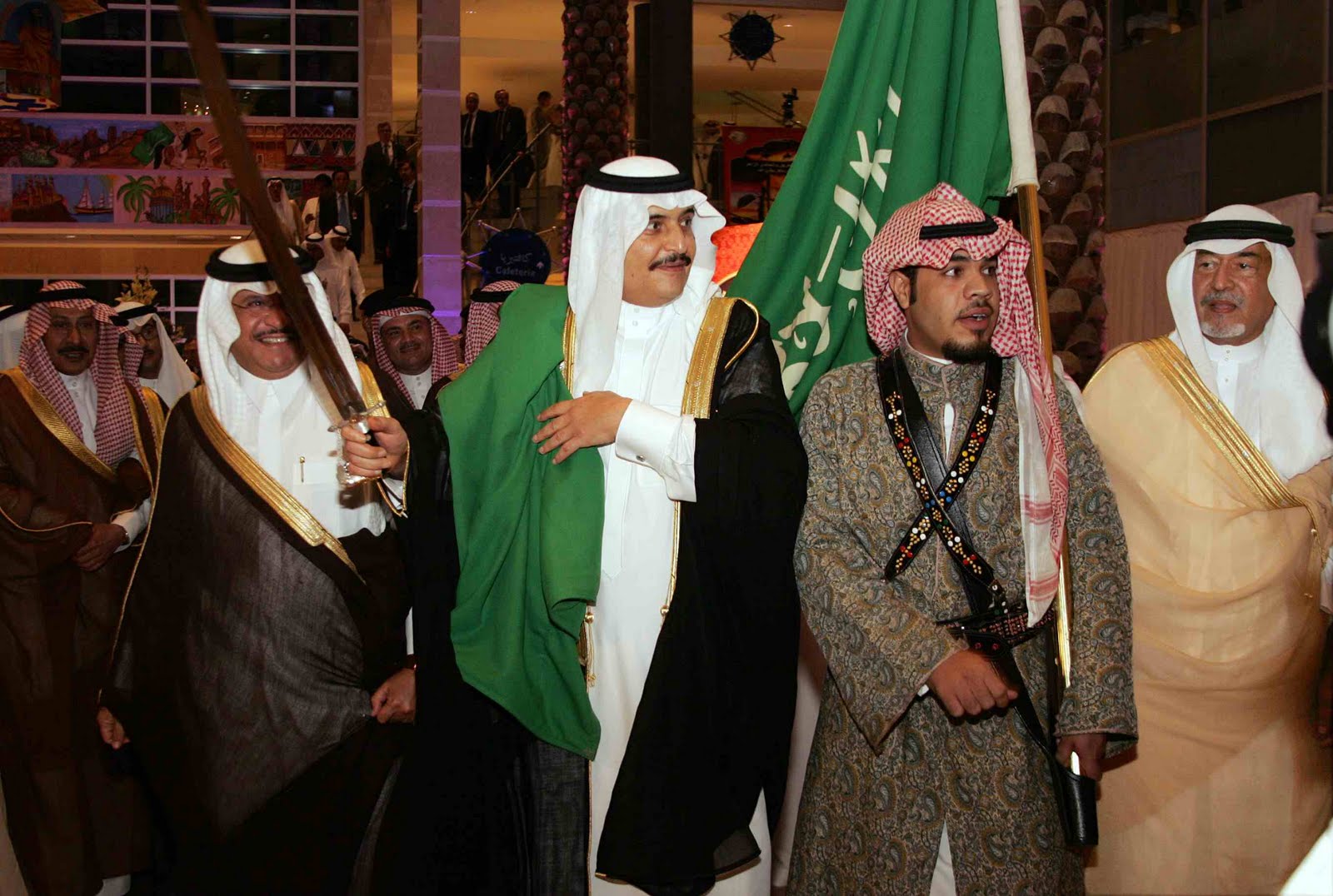
A number of high-ranking Saudis and foreign diplomats led by Eastern Province Gov. Prince Muhammad bin Fahd and prominent Jeddah businessman Khaled Alireza traveled through space and time on Sunday, Oct. 2, 2011, at the premiere of the spectacular new 3D film called "Arabia" at the Sultan bin Abdul Aziz Science and Technology Center's IMAX theater in Alkhobar.

The 45-minute feature is the first to be entirely shot in Saudi Arabia, and it spans 2,000 years of history in the Arabian Peninsula. Presented in the impressive IMAX surround film format, viewers enjoyed a mix of stunning photography, interesting history and contemporary commentary. It is produced and distributed by MacGillivray Freeman Films and presented in association with the Royal Geographical Society, the Oxford Center for Islamic Studies, and the King Faisal Center for Research and Islamic Studies.

Well-known Saudi companies such as Xenel Group, Safra Co. Ltd., Flour Corp., Saudi Cable Co., Zahid Group, Alujain Corp., Hidada Ltd., and Tareq Taher provided major funding for the film.

As the only IMAX theater in Saudi Arabia, it was appropriate to present "Arabia" at Alkhobar's popular Scitech Center. Princes, bureaucrats, diplomats, academics, writers and other notable persons from across the Kingdom turned out for the screening. They included former Culture and Information Minister Iyad Madani, film director Greg MacGillivray, his wife Barbara MacGillivray, Arab News Editor in Chief Khaled Almaeena, historian and best-selling author Robert Lacey, Scitech Director General Muhammad A. Garwan and King Fahd University of Petroleum and Minerals Rector Khaled S. Al-Sultan.

"It is a fantastic movie," said Prince Muhammad after the premiere. "The film highlights the true spirit of Saudi Arabia."

"Arabia" is the realization of MacGillivray's vision as told through the eyes of 26-year-old Saudi film student Hamzah Jamjoom, who sets out across the country to explore its history and cultural and geographic diversity. Jamjoom is working on a master's degree in cinematography at DePaul University in Chicago, and his role in this film certainly will bolster the student's career.

The film spans 2,000 years of history and the three "golden ages" of Arabia -- the Nabatean Empire, the Islamic Age, and the current era of oil wealth and technological development.

Jamjoom travels to Riyadh, to the ancient tombs of Madain Saleh, and to the holy city of Makkah. There are some spectacular scenes, especially the aerial views of the Grand Mosque during the Haj, where the sight and sound of thousands of worshippers praying together is akin to a gentle ocean tide.

Although the film is intended for a global audience, Saudis were amazed by their nation's incredible geographic and cultural diversity when seen through the giant-screen views of the exotic peninsula's wilderness and vast cities. The IMAX camera in a helicopter drifts over these landscapes, and then maneuvers through traffic and crowds of people.

"It is dramatic," said Almaeena. "It is to be seen to be believed; there is no doubt that this producer (Greg MacGillivray) is a genius. Saudi Arabia needs a couple of such films to dispel all the wrong notions that people in the outside world have about us."

The film's magic carpet touches down in Riyadh, Jeddah and Dammam. Along the way viewers experience giant dunes larger than the Eiffel Tower, pyramidal skyscrapers, Bedouin tribesmen, and other details of the fastest modernizing nation on earth. Well-staged scenes and even brief animation ably filled viewers in on the region's 2,000-year history.

From the earliest days of the Nabatean frankincense traders to the rise of Islam and the region's intellectual flowering, Arabia has twice risen to global prominence in what scholars say are two distinct Golden Eras: the Nabatean Era (100BCE to 400CE) and the Islamic Golden Era (700CE to 1400CE). During this period of "lost history," Arabian scholarship led to unprecedented advances in science, medicine, mathematics and the arts.

The film takes viewers to the ancient tombs of the lost city of Madain Saleh, where early Nabatean nomads established the region's first camel way station along the frankincense trade route more than 2,000 years ago. They visit the refreshing oasis village of Al-Ula where camel caravans sold their wares in the historic Bedouin markets and souks. They share the legendary hospitality of a Bedouin family and the warmth and glow of their lamp-lit tent. And they explore ancient shipwrecks beneath the Red Sea where today's archaeologists are searching through this sunken museum for clues to the secrets of the ancient past.

"Arabia" offers its audience an opportunity to travel to a distant land, see a country largely hidden from view, and experience a culture people know little about. The aim of the film is to educate, entertain and encourage understanding at a time when it is urgently needed. On a spectacular visual journey across this desert nation, the film portrays the people, religion, and geography of the Kingdom of Saudi Arabia.

"Arabia" includes amazing aerials, historical imagery and reenactments, as well as heartfelt scenes of ordinary life among people living in exotic, sometimes surprising, locations. The climax of the film takes place at Makkah's Grand Mosque, where 3 million pilgrims gather each year for the Haj. As pilgrims from all over the globe go around the Holy Kaaba in peace and goodwill, viewers have an opportunity to glimpse the spirit of Islam during the largest international gathering in the world. A spirit without which Saudi Arabia would not exist as it does today.

Saturday, July 16, 2011

OIC, West Pledge to Combat Intolerance


OIC, West pledge to combat intolerance

By SIRAJ WAHAB
Published in Arab News on July 17, 2011

ISTANBUL: In what can rightly be described as a seminal step in relations between the Muslim world and the Western world, the Organization of Islamic Cooperation and the leading nations of the Western world led by the United States and the European Union agreed Friday to take concrete steps to combat intolerance, negative stereotyping and discrimination, incitement to violence, and violence against persons based on religion or belief.

The high-level meeting was held at the historic Yildiz Palace in Istanbul. It was attended by EU High Representative for Foreign Affairs Cathrine Ashton along with foreign ministers and officials from France, Germany, Britain, Italy, Japan, Australia, Belgium, Canada, Poland, Romania, Denmark, Egypt, Jordan, Lebanon, Morocco, Pakistan, Senegal, Sudan, the Vatican, UN Office of the High Commissioner for Human Rights, Arab League and African Union. The meeting was co-chaired by OIC Secretary-General Ekmeleddin Ihsanoglu and US Secretary of State Hillary Clinton.

Ever since he took office, the OIC secretary-general has been working on formulating ways and means to stop acts of religious intolerance.

“It was during my address to the 15th session of the Human Rights Council in Geneva that I outlined a new approach toward evolving a consensus against incitement to violence and intolerance on religious grounds that could endanger peaceful coexistence and must be viewed as a direct contrast to the very notion of a globalized world,” said Ihsanoglu. “I am glad that the eight points in the proposed approach found resonance with all the negotiating partners. They formed the basis of the consensus reflected in Human Rights Council Resolution 16/18. The importance of the consensual adoption of this resolution should be duly recognized.”

He said challenges remain.

“However, the test would lie in the implementation. Having been successful at consensus building, we must now act in concert to build on the consensus. The adoption of the resolution does not mark the end of the road. It rather signifies a beginning based on a new approach to deal with the whole set of interrelated issues,” said Ihsanoglu. “Resolution 16/18 provides a good basis for concerted action by states, at both national and international levels and must be utilized accordingly. Otherwise, we would be faced with the unaffordable risk of the agenda being hijacked and set by radicals and non-state actors.”

Ihsanoglu said there was a delicate balance between freedom of expression and incendiary speech.

“We continue to be particularly disturbed by attitudes of certain individuals or groups exploiting the freedom of expression to incite hatred by demonizing purposefully the religions and their followers. Though we respect their freedom of opinion and expression, we find these attitudes politically and ethically incorrect and insensitive.”

At the meeting, Clinton discussed how to build on a UN Human Rights Council resolution passed on March 24 that calls for promoting tolerance and respect for diversity of beliefs, without restricting legitimate free speech.

Clinton agreed to pursue a new religious tolerance agreement, which respects free expression of religious beliefs in order to resolve debates over religion between the West and the Islamic world.

“Together we have begun to overcome the false divide that pits religious sensitivities against freedom of religion,” Clinton said. “We are pursuing a new approach based on concrete steps to fight intolerance wherever it occurs.”

Speaking of the United States, Clinton said: “We have seen in the United States how the incendiary actions of just a very few people can create wide ripples of intolerance, so we are focused on promoting interfaith education and collaboration, enforcing anti-discrimination laws, protecting the rights of all people to worship as they choose, and to use some old-fashioned techniques of peer pressure and shaming so that people don’t feel that they have the support to do what we abhor.”

She recalled a dialogue with Ihsanoglu and leaders of Istanbul’s diverse religious communities 15 years ago.

“That conversation took place just a few months after the signing of the Dayton Accords. We were all deeply concerned about the sectarian tensions and violence, and we were all troubled by what we had seen happen in the Balkans," she said. “I had come from Sarajevo and Tuzla, where I had met with Bosnians, Serbs, Croats, and Muslims all together, and I will never forget one woman saying that neighbor began turning on neighbor because of religious and ethnic differences. And this woman asked a friend from another religious background, ‘We’ve known each other for so long; we have celebrated each other’s weddings; we’ve buried each other’s family; why is this happening?’ And her friend replied: ‘We were told that if we did not do this to you, you would do it to us.’ And it was as clear a statement of what incitement to violence and hatred can lead to as any that I have heard. And the conflict proved so costly, we are still living with the consequences today.”

She commended the Organization of Islamic Cooperation for its work securing the passage of Resolution 16/18 at the Human Rights Council.

“Resolution 16/18 calls upon states to protect freedom of religion, to counter offensive expression through education, interfaith dialogue, and public debate, and to prohibit discrimination, profiling, and hate crimes, but not to criminalize speech unless there is an incitement to imminent violence. We will be looking to all countries to hold themselves accountable and to join us in reporting to the UN’s Office of the High Commissioner of Human Rights on their progress in taking these steps.”

Sunday, May 15, 2011

World's Largest University Gives Saudi Women Hope for Change


By Siraj Wahab
http://arabnews.com/saudiarabia/article406052.ece


Saudi women educators and professionals were upbeat about the opening on Sunday, May 15, of Princess Nora bint Abdulrahman University (PNU) in Riyadh and took it as a sign that women may start to assume a more active role in the Kingdom’s development.


Custodian of the Two Holy Mosques King Abdullah inaugurated the SR20 billion university, 25 km east of the Saudi capital, amid cheers of over 2,000 students and faculty members. With a capacity to enroll about 50,000 students, the PNU is the largest women-only university in the world and part of an ambitious education plan of the Saudi government. The university's residential area has about 1,400 villas and its massive hostel facilities to accommodate 12,000 students. The sprawling campus sits on a site that exceeds 800 hectares.

“I hope it will lead to a massive turnaround in the fortunes of Saudi women,” said Dr. Aisha Almana, founder of Alkhobar’s Mohammed Almana College of Health Sciences. “However, universities of the world are not known by their physical structure — they attain status and credibility by what they produce. I mean a university is known by the quality of its graduates. I hope the new university will be a trendsetter. We all know that women constitute 50 percent of the Saudi population. Recent statistics, at least those from University of Dammam, indicate that there are more women graduates than men. Meaning women are more aware of the need for education. They are equal partners in the development and progress of this great nation.”

Almana said Saudi Arabia should concentrate on making its people productive. “Oil is here today, and it may not be here tomorrow. Look at Japan; they had no natural resources, but it is one of most robust economies in the world — just by the sheer power of their people. We should focus on investing in human capital. It is our people who will take us far. We should concentrate on creating excellent human resources. People are our greatest asset, and we should nurture them.”


Jeddah broadcaster and newspaper columnist Samar Fatany said the new university should be a source of pride for the Kingdom.

“It has bright prospects,” Fatany told Arab News. “It will inspire the young generation of Saudi women. Hopefully it will bring in a new trend of positive thinking and produce a new group of educated women who will eventually assume leadership positions in their respective fields. We need such universities to help us excel. The new university will help our women to compete with the best women in the world and create healthy competition within the various universities in the Kingdom. It will raise the benchmark of education.”

“First and foremost it indicates Custodian of the Two Holy Mosques King Abdullah’s support for women,” said writer and physician Dr. Samia Amoudi. “This is a big step in the empowerment of Saudi women. It is also significant that it is named after Princess Nora bint Abdulrahman who is the sister of the king. “For such a large, prestigious project to be named after a woman is an honor for all of us. It will have a great impact on society and how it perceives us women. I am very happy that our leadership is aware of our needs. They have placed their trust in us.”

“Now it’s the turn and the responsibility of the women of our Kingdom to ensure that this university attains a high rank in the world and the Middle East in particular,” said Jubail teacher Huda Al-Shehri. “This university is the first of its kind dedicated exclusively to women. It offers courses that are not traditional or conventional in nature. These courses are more in line with the needs of the job market.”

Almana agreed.

“It is my conviction that we should follow the India model. Immediately after attaining independence, they concentrated on professional courses rather than humanities and arts,” she said. “The recent turnaround in India is a result of that paradigm shift in education. I recently came back from Bangalore and saw the transformation myself. We should similarly focus on professional studies.”


Friday, May 13, 2011

Civil Breakdown, Conspiracy Fears Worry Pakistani Expats in Saudi Arabia

By Siraj Wahab

As the Pakistani Taleban took credit for the murder on Friday, May 13, of 80 Pakistanis in retaliation for the raid 10 days ago in which Osama Bil Laden was killed, the reaction from Pakistani nationals in Saudi Arabia ranged from disgust and disdain to conspiracy theories and blame for the United States.

“The United States is playing a very dangerous game in our country,” said a senior Alkhobar-based Pakistani executive who requested anonymity. “While the bombers may have been Pakistanis, the command and control is in the hands of those who are miles away from our country.”

Others put the blame a little closer to home.

“I condemn the blasts. There is no doubt they have been carried out the Pakistani Taleban,” said Jeddah-based engineer Syed Mutahir Rizvi. “They have claimed responsibility for the blasts. There is no reason for us to say that someone else is involved. I can understand the anger of some Pakistanis at what has happened, but this is no way of expressing their anger. Why should innocent people be made to suffer for something they have nothing to do with?”

Well-known writer and poet Habib Siddiqui presented a dismal appraisal of the breakdown of civil society in Pakistan after a recent visit.

“I see no hope,” Siddiqui told Arab News. “I have just come back from Karachi — there is not a single home that has not been burgled. There is total chaos and lawlessness. There is no rule of law; no one is safe. Those who have survived Friday’s attacks should count themselves lucky. Those who died leave behind widows and children. No one will take care of them. They are mere statistics in a long and dirty war,” he said. “The worst part about this war is that nobody knows who is on whose side and who is killing whom?”

Anjum Dar, the Alkhobar-based president of the Ideological Forum for Pakistan Studies, said innocent people have been caught in a crossfire between two equally entrenched adversaries. “Ordinary Pakistanis are confused and rattled by the developments that have turned their country upside down,” he said. “The reins of power are in the hands of a select group of nine or 10 people, who do not belong to any political party, who have pledged to do whatever is asked of them by foreign countries. They are dutifully following and carrying the foreign agenda,” he said rather ruefully.

Dar said the militants try to justify such acts because of the alliance between Pakistan and the United States.

“They are convinced that the political establishment and the army are not there to defend the people of Pakistan, that they are in league with the US and that the drone attacks are being carried out with active help from the army and the intelligence agencies,” he said. “That is what people think. When our government started taking the American line that is when things deteriorated and here we are today — in total chaos.”

Some Pakistanis are convinced that all of it is a sinister American plot.

“All this is very well scripted. More blasts will follow and we will have the same explanation: that Taleban carried them out,” said the anonymous executive. “I don't believe anything that is coming out in the press. Our current rulers have sold their souls to the United States. That is it.”

Saturday, May 7, 2011

Mohammad Azharuddin Wows Jamia Millia Islamia Alumni in Riyadh


By Siraj Wahab

RIYADH: A onetime cricket star and current member of India’s Parliament told the Jamia Millia Islamia Alumni Association it was time for Indian Muslims to stand together for the common good and educational advancement of the community.

Mohammad Azharuddin made the comments Friday (May 6, 2011) at the Riyadh Palace Hotel where alumni were marking the Muslim university’s 90th anniversary.

Azharuddin noted the significance of the minority institution status granted by Indian government that allows the university to reserve up to 50 percent seats for Muslims. “I congratulate Jamia Millia Islamia, its administration, its faculty, its illustrious alumni here in Riyadh and Saudi Arabia and other Gulf countries and all those associated with this great institution of learning for having being formally and legally recognized as a minority institution. This is a victory for all,” he said.

“We have no hesitation in holding that Jamia was founded by the Muslims for the benefit of the Muslims and it never lost its identity as a Muslim minority educational institution,” National Commission for Minority Educational Institutions (NCMEI) Chairman Justice M.S.A. Siddiqui ruled when granting the special status.

“This was a long-pending demand, and if it had been conceded earlier it would have resulted in the university going far ahead,” said Azharuddin. “It is a historic university, and it has played a pivotal role in India’s struggle for independence; the university had the greatest support from the country’s independence hero Gandhiji, and despite all the challenges that it has faced in all these 90 years it has done very well,” he said.

As a member of Parliament, Azharuddin said he would lend full support for a similar status for Aligarh Muslim University. “These universities are among the oldest and most reputable universities. Efforts should be made to ensure that they remain committed to the vision with which they were created. I am very happy to note the prominent positions that Jamia alumni occupy in Saudi Arabia. This is a source of strength for the Indian community,” he said.

Drawing a parallel from the game of cricket, he said many of the problems the Indian Muslim community faces are a result of the serious lack of team effort. “We are ready to take up your cases, and we are ready to fight, but the community needs to be united. If the team is not united, you don’t win matches. I can’t play on the front foot if I realize that there is not enough support in the back. I am then forced to play on the back foot,” he said much to the laughter of all those who gathered.

He expressed his unhappiness at the turn of events at Aligarh Muslim University. “One gets upset when one keeps hearing about the frequent lockouts at the university. This is not a happy sign. All those who are working for the good of such universities should be supported to the fullest. We should not let our infighting harm the institution,” he said and admitted that “more than the outsiders it is the internal differences that are the greatest challenge to our institutions.”

Prominent educator and industrialist Nadeem Tareen highlighted the good work being done by the Indian expat community on the education front. “There is a new awakening among Indian Muslims. They want to make rapid advancements in the educational field, and they are succeeding, both through individual and collective efforts,” he said and advised his fellow expats to explore more possibilities on how to make education available to those in less-literate areas of the country.

He said differences were not necessarily a bad thing. “The old boys of Aligarh Muslim University disagreed with the university’s approach toward the freedom movement in the 1920s and hence launched Jamia Millia Islamia. It turned out to be a good decision — a blessing in disguise. There are lessons to be learned from how those with differing opinions conducted themselves in those days. For them the community’s interest was paramount, and that is how it should be even now.”

JMI Alumni Association President Murshid Kamal recalled the circumstances through which the university came into existence and said the granting of the new status calls for greater effort to turn it into one of India’s Top 10 universities. “If we fail then our adversaries will have a reason to mock us. We should not provide them with a reason to say, ‘Look, didn’t we say they will make a mess out of themselves, and they did’ ... That should not happen.”

The evening saw the presence of the who’s who of the Indian community in Riyadh. The evening was anchored with panache by M. Shahabuddin. Aftab Nizami thanked all those who turned up at the event. All the previous presidents of the alumni association were honored on the occasion, including its popular founder Shafaatullah Khan.

Azharuddin was later mobbed by fans who took his autographs on every imaginable article including cricket bats, balls and T-shirts.

Monday, April 4, 2011

Prince Turki Al-Faisal Explains Kingdom’s Bond With Its People

By Siraj Wahab
sirajwahab@arabnews.com

Former Saudi Ambassador to Washington and London Prince Turki Al-Faisal highlighted Saudi Arabia’s national unity and its long march toward development recently in a speech delivered to the Middle East Association (MEA) at The Dorchester Hotel in London.

Prince Turki, who now heads the Riyadh-based King Faisal Center for Research and Islamic Studies, detailed the Kingdom’s progress since 1925 and the institution of the Shoura Council through the present day. He explained the differences between the governments that have drawn sharp criticism from their citizens and Saudi Arabia.

“Despite the turmoil taking place in so many Middle Eastern nations, as well as predictions among some pundits that such turmoil is bound to find its way into the Kingdom, the history of the Saudi State is in fact the history of a government that has developed over time in response to the needs of its people, and it is a progressive, active, modern political entity that due to its past actions is uniquely secure in its future,” said Prince Turki.

He noted that the Kingdom has long battled extremism masquerading as religious fervor and that the terror attacks actually have brought the Saudi people together.

“Saudi Arabia began experiencing an assertive Saudi nationalism that fully transcends tribal and regional allegiances,” he said. “While it has many causes, a few of the most important are the first Iraq War of 1990, from which we emerged victorious over an odious and malignant Saddam Hussein, the attacks of Al-Qaeda on the United States and the Kingdom in 2001 and 2003 respectively, which led to an introspective revaluation of our values and beliefs, and the rise of an aggressive Iran over the last 10 years. These events brought about a strong sense of national unity in the Saudi people, and we are still seeing the ripple effects of this assertive nationalism today.”

The Kingdom has continued to develop both global and regional roles, and Prince Turki spoke of an era of internationalism through which Custodian of the Two Holy Mosques King Abdullah is guiding the country.

“We have seen the Saudi State progress in its sophistication through such policy institutions as the Supreme Economic Council, the National Dialogue Center, and the Council for Succession ... but we have also seen the Saudi State looking outward in an ever-more focused and responsible manner, attempting to bring stability to the region of which it is such a vital member,” he said. “It is important to note that internal and external progress is linked closely together. A nation cannot be a strong and respected international player unless it is strong domestically, and this fact has guided the actions of the Saudi government.”

Empowering Saudi women continues to be a priority as is evidenced through continuing changes in the national perspective.

“To honor King Fahd’s belief that women and men should have equal roles in the development of the Kingdom, as stated in his previously mentioned speech to the Majlis Al-Shura in 2003, King Abdullah expanded women’s education to all fields of knowledge and built the King Abdullah University of Science and Technology,” said Prince Turki. “He introduced the National Dialogue in which Saudis of both sexes and from a variety of socio-economic categories discuss controversial issues such as terrorism, women’s role in society, educational reform, religious speech, and many others. In its eighth year now, the dialogue moves from town to town, province to province, holding public meetings in which anyone can say whatever he or she wishes, and all the sessions are televised so that the public can follow along. It is a very Saudi way of soul-searching and engaging in participatory discussion, and we strongly believe that it is the right direction for our country to take as we look for newer and more innovative ways to involve all Saudis in the discourse about the direction their country should take.”

Prince Turki said King Abdullah places high importance on providing the best education possible for future generations of Saudi citizens.

“He expanded the scholarship program for Saudi students to study abroad and we now have more than 100,000 young people attending the finest academic institutions in more than 50 countries. He also quadrupled the number of Saudi universities to meet the demands of a growing number of Saudi youngsters who want to acquire the skills to meet the complex demands of the future while remaining in their home country.”

Prince Turki said the king considers the King Abdullah University of Science and Technology (KAUST) as the jewel in the Kingdom’s educational crown and evidence of its commitment to diversity.

“It is a postgraduate research university where the student population is more than 65 percent non-Saudi, where the president is a Singaporean Chinese scientist, and where the board of trustees is composed of distinguished academics and civic leaders from all over the world,” he said. “This is a truly remarkable achievement that not only helps the Kingdom open up its intellectual horizons to the rest of the world, but it also stands as a strong statement against those nihilistic and xenophobic forces that seek to destroy the Kingdom in the name of radical extremism rather than build it up in the name of Islam.”

He said the Saudi people are aware of their government’s efforts on their behalf and that this distinguished the Kingdom from those places that have been shaken by dissent.

“The Kingdom is a place of progress and stability, and this progress and stability have been hard won by actions of the past, which continue very much today as the nation strives for a better future,” the prince said. “Unlike so many countries that are now encountering unrest, Saudi Arabia has seen practically no turmoil within its borders, and there is a very simple reason for this. The Saudi people, unlike those in Tunisia, Egypt, Libya and elsewhere, have not been the subjects of neglect and corruption, but instead have been active and valued participants in the creation of a fully progressive, modern, inclusive state. The Kingdom and its people, from the king to the schoolchild, do not have the arrogance to believe that we have reached perfection. We have a long way ahead of us, of turmoil and struggle, of ambition and accomplishments, of tearing down walls of bigotry and hatred. For this reason, the vast majority of the people support their country.”

Prince Turki quoted William Shakespeare to describe the relationship between the government and the people of Saudi Arabia.

“In exchange for this loyalty, the Saudi leadership will tirelessly pursue its agenda of improving the government institutions to better address and improve the lives of its people — an agenda it has been pursuing for more than 80 years, taking to heart Shakespeare’s assessment of the nation’s role in our lives in Titus Andronicus: ‘to heal harms and wipe away woes.’ As you have seen, what was supposed to be and loudly touted by your media organs as a ‘Day of Rage’ (March 11) in the Kingdom turned out to be a ‘Day of Tranquility,’ as any Friday is in the land of Islam.”

Thursday, March 10, 2011

Business as Usual in Saudi Arabia as Foreign Correspondents Chase Nonexistent Story

By Siraj Wahab in the eastern Saudi city of Qatif

Foreign correspondents dispatched to Saudi Arabia's Eastern Province to cover the “Day of Rage” touted on social media websites are reporting there is nothing much to report.

On Thursday, families were making purchases in shops and malls and there was normal traffic flow in Qatif, Dammam and Alkhobar streets as people sat in coffee shops chatting and reading newspapers. Despite all the normality, however, some expatriates, especially the Westerners, did have their apprehensions.

Reporters and correspondents usually assigned to the Eastern Province are primarily concerned with the Saudi Arabia’s energy business; political reporters are based in Riyadh. This week, however, many of the Riyadh-based writers have traveled to the Eastern Province to cover "political unrest" and are finding nothing but business as usual.

Foreign Minister Prince Saud Al-Faisal acknowledged on Wednesday (March 9) that there was a protest march last week, but the protesters were invited to share their concerns peacefully and through proper channels.

“When a group of our brothers came out, a police officer asked them whether they see any hindrance before them to present their demands to the Saudi authorities as their offices are open to all,” Prince Saud said. “We have seen Custodian of the Two Holy Mosques King Abdullah receiving groups of citizens from the Eastern Province and other parts of the Kingdom on Tuesday. The officer then told them to give their demands in writing. They then presented their demands and went back to their homes.”

In the nations that have faced protests and unrest, people have complained about unresponsive, corrupt leaders and chronic economic stagnation. In Saudi Arabia, the government has had a national dialogue in progress for several years, continuing multiple investments in employment-boosting industrial projects and economic cities across the Kingdom as well as one of the largest college scholarship programs in the world.

“The irony is that if you ask most people who Saudi Arabia’s lead reformer is they will tell you it is King Abdullah,” said one reporter. “If anything, he is waiting for the country to catch up to him.”

International news agencies went viral with reports about protests in Qatif. To add to the confusion, a Facebook page about planned protests Friday attracted lots of attention and has thousands of members. The Saudi government has made no effort to close it or Facebook. What is unknown is how many page members are actually Saudi.

“Anybody from Tanzania to Timbuktu can join any Facebook page,” said another correspondent. “Since there is a lot of curiosity many people who know nothing about Saudi Arabia seem to have joined this page creating even greater confusion.”

The potential problems arising from such circumstances when international news agencies amplify such social networking pages are obvious.

“I don’t know from where my bosses in the States are getting all kind of weird stories — that tanks are rolling in the Eastern Province, that there is a curfew in many towns,” said one foreign journalist who has been combing the Eastern Province for two days in search of a story. “I am sitting here in one of the best-known hotels in Alkhobar, and everything is so normal. In fact, on the way to this hotel I did not see a single checkpoint. What are these people talking about? Where are they getting their information from? If someone writes something on the blog it becomes viral. If someone posts a video on YouTube it becomes the rage in Western capitals. Nobody has the time to check the veracity and the truthfulness of these videos.”

The "investigative reporting" into civil unrest continues.

“The other day I visited most of the towns and saw nothing,” she said. “That is a story in itself, but my bosses are not interested in a business-as-usual story. They need a sensational story — one that fits whatever negative news they are hearing about Saudi Arabia. They see Saudi Arabia protests as a sexy story — a hot-button story."

On Thursday morning in Alkhobar, shoppers purchased items at malls and grocery stores. Some people went to breakfast and then went onto their next destinations on what appeared to be normally busy streets and highways.

In Qatif, Arab News witnessed more shopping and more coffee drinking. Families were busy enjoying a cool weather. There were no policemen or police cars in sight. However, that is not the impression one gets after watching all those television channels, and in global newsrooms scattered around the world, editors clamor for more details about the nonexistent “tinderbox".

“I don’t know what to do. I simply talk to the local people, compile their quotes and submit it to my bosses,” said another perplexed foreign correspondent. “The next day I find a very wonderfully written and highly sensational story full of spicy details with the quotes interspersed very nicely in between.”

The reporters seem committed to accuracy and factual reporting — at least on their part. As for what their editors do with those reporters’ reports in this case it truly appears to be another story.

“If that is what they want to do, let them do it,” said the correspondent. “This is the hazard of working with international news agencies. You don’t control the story. Your job is merely to provide information. It is the editors in the newsrooms in London, Paris and Washington who decide how to use that information and what angle to take.”

So as an anxious international press corps waits at the ready, it might be a nice day to enjoy the cool weather and a coffee along the beautiful beaches.

Wednesday, February 23, 2011

King Abdullah Arrives Home Amid Massive Celebrations

By Siraj Wahab in Riyadh
sirajwahab@arabnews.com

Custodian of the Two Holy Mosques King Abdullah’s return home sparked celebrations among Saudis and expatriates alike. The nation’s capital has become the site of an impromptu festival. King Abdullah arrived in his homeland on Wednesday after three months abroad. He had gone to New York on November 22 and underwent surgery two days later for a debilitating herniated disc complicated by a haematoma.

The iconic Faisaliah Tower on Riyadh's Olaya Street was bathed in green light symbolizing the Saudi flag, and the streets are filled with people carrying Saudi flags along with posters of King Abdullah. As the king's plane touched down, jet fighters of the Saudi Royal Air Force jets took to the sky to perform spectacular aerobatics, forming the Kingdom’s national symbol of crossed swords over a palm tree with their contrails. Men in white garb performed a traditional Saudi dance called "ardha" while well-wishers including women and children waited to see their ruler.

Happy onlookers cheered as the jets performed their aerobatic display. “We are very happy because our leader is back among us,” said an elderly man celebrating near the historic Masmak Fort in the city's old quarters. “My son is even happier because he works for the government, and King Abdullah has announced fabulous pay hikes for government employees,” he said. “I worked in the past for the military as a maintenance technician, and I am told that our king has raised the amount of pension to all retirees. That is an additional reason for me to celebrate,” he said smiling broadly.

Twenty-seven-year-old Mahmoud Fallata who works with Saudi Telecom Co. said he has never seen such happiness in his lifetime. “Everybody is cheering. Everyone at home is glued to television sets watching each and every story about our king. Our company and other telecom companies have announced huge reductions in call rates and text message charges,” he said. “At home and at school children are chanting 'Baba Abdullah, Baba Abdullah'. It’s like an Eid celebration,” he said,

As the evening wore on hundreds of smiling Saudi youths took to the streets, which were filled by 3 p.m. For Saudis, Wednesday is the beginning of the weekend, but the government declaration of a holiday Saturday has given everyone an extended weekend.

Expatriates also were jubilant. “There is something unique about this king. Ever since he took over, the Kingdom has been blessed with great prosperity. Masha-Allah,” said Atta Shukri, a pharmacist from Egypt. “When I landed here nine years ago, the economy seemed in a bad shape. Today,Saudi Arabia has emerged as the most financially stable country in the world ... All this is thanks to the prudent policies of King Abdullah,” he said.

“As an expat who has been given the opportunity to earn a living here, I feel very happy at this moment,” said Pakistani schoolteacher Shakir Moyeen. “It is such a nice feeling to see happiness written large on the faces of our hosts. They are smiling and exchanging greetings. That this king is so popular is evident from the faces and body language of the Saudis.”

For King Saud University student Wael Abdul Rahman, the return of King Abdullah means he has to visit the holy cities of Makkah and Madinah to say thanksgiving prayers. “I had taken this vow that I would perform Umrah when our beloved king returned hale and hearty. Today, I have to honor that pledge. I am leaving Wednesday night to Makkah. I can’t describe my happiness,” he said.

In sharp contrast to some countries where young people have taken to the streets calling on unresponsive governments for needed reforms, many young Saudis hold that King Abdullah is the leader of the Kingdom’s reform movement.

“For us young Saudis, this king has meant a lot. He has taken special care of us. He announced so many scholarships — sent so many students abroad to study, and more importantly he restored the image of Saudis in the eyes of the world,” he said. “After 9/11 we were seen with lot of suspicion. He gave us confidence and taught us the values of moderation and won the respect of the world with his interfaith dialogue and national dialogue initiatives."


End of an Era: Dr. Majid Kazi Is No More

Dr. Majid Kazi is no more By Siraj Wahab in Jeddah Friday, November 8, 2019 Dr. Majid Kazi, the personal physician to the late S...